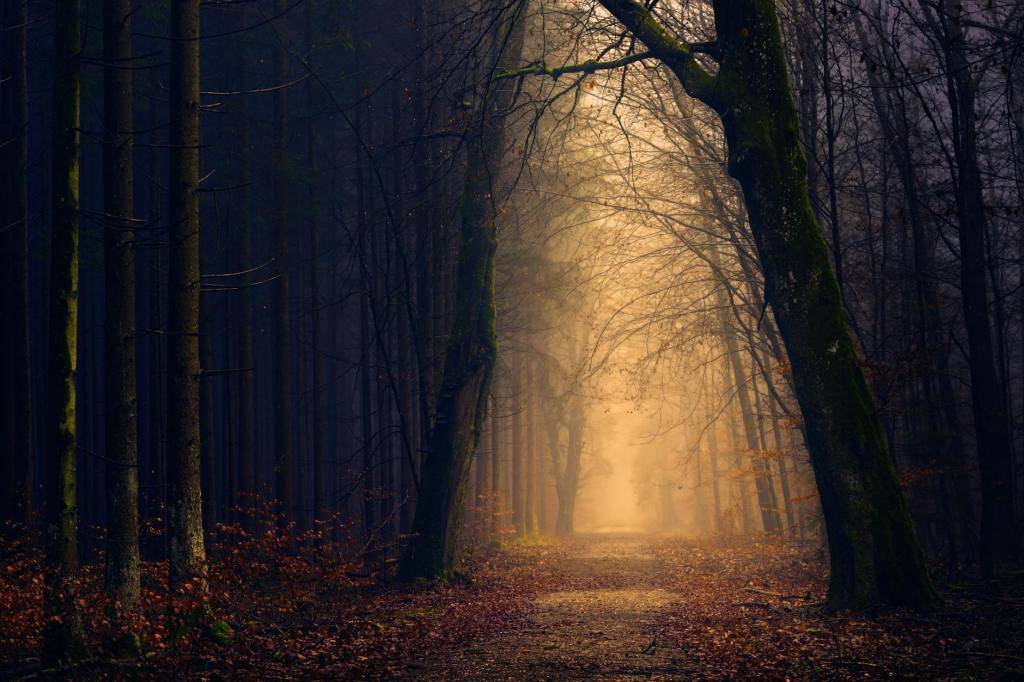
You can taste the fall: that brittle, clean chill on the too-blue edge of a late-autumn dawn, half-gleaming in your throat and lungs. Beyond the grasping branches laced in the withered fire of dying leaves, you can see thin clouds streaked across the morning sky. Frost gathers on limbs that have already shorn themselves of their summer bounty; in some places, the ice gathers in dewy prisms, daytime stars in the arches above you.
It might have been peaceful, were you peaceful yourself. But you aren’t. That half-gleaming breath, cool and bright in your lungs, emerges from your mouth in ragged, aching sobs, only to be pulled back in again in heaving gasps. Your hands tremble under the rush of riverwater, sallow and wrinkled and very nearly blue with cold, and yet you cannot seem to get the last of the man’s blood from beneath your fingernails.
He would not listen, you tell yourself. He would not hear. It was you or him, you swear, to no one, to nothing. He would have killed you, given the chance. He would have gutted you like a gasping fish, laid out along the road for no one to remember and no one to mourn. You did what you had to do – but the warm rush of the blood from his open throat still clings to your skin, adheres to something beneath your skin, a stain you’ll never get out. It is a bone-deep corruption, a marrowborne changing of who you are.
You can see your scattered, muddled reflection in the burbling mirror of the river. You can see your own furrowed brow, your own horrified stare, the clench of your jaw and the thin slash of the grimace stretched across your face. None of it feels like yours anymore – features that belong to someone else. It isn’t you anymore.
You knew the man, which made it worse. He was a farmer, there on the very edge of the forest. He had plenty. He had all he needed and more. All you wanted was some food for yourself. He could have spared it. Surely it wasn’t worth dying for. Surely, it wasn’t worth killing for. All he had to do was send you on your way with the little sack – now scattered at your feet, most of the stolen vegetables now split or flattened during your stumbling rush to the water – you’d gathered for yourself. But no, he took an axe in hand and charged after you, rage on his face the likes of which you didn’t think him capable.
You remember your arm snapping up, the little knife you used to cut stems and roots clutched in your hand. You remember the surprised fear on his face as the blade parted his skin the way a scythe parts grass. You remember the blood splattering over you, your clothes, into your mouth. You can still taste it, despite the mouthfuls of riverwater you’ve swallowed – copper on your tongue, coins for the dead. You cannot get the blood out of your mouth, you discover, same as your skin, same as your marrow.
You are trying again anyway, gulping down chilled water, when you first realize someone is watching you from the other side of the river. The shock is enough to make you choke, and sputter; you wrench yourself backward, one hand scrabbling through the scattered leaves of the forest floor to find your knife. (Something in you grins horribly at your instinct, even now, even after everything, to go for your knife.) The figure appears to be dressed in a cloak made of autumn leaves, draped over thin shoulders and a too-tall body. The cloak obscures much of their face, save for a thin, sharp, pale chin – and a strange, mirthless smile.
There is blood on you, child, the figure murmurs. You flinch. They stand all the way across the water, and yet their voice lilts into your ear as though they lingered just behind you. You swear for a moment you could feel their breath, frigid and damp, along the back of your neck. No – there they are, standing just at the line where the water meets the land on the other side of the river. You cannot tell if the tremble in their shoulders is a shiver in the cold, or the gentle sway of the leaves on their cloak.
You must have been so hungry, the figure continues. You must have felt so empty. There you were, quivering and hollow, and there they were, the fruits of his labor. Far enough away from the village to hide your theft from others, close enough to ferret back into your little hovel. Just a few, you told yourself. Enough to get by. Enough to get by. Winter is coming, after all.
You watch as the figure lifts their head enough for the hood of their cloak to recede. Their skin is bronzed ochre; their eyes glint like gray-blue cobblestones sat deep in their sockets, wide and staring. That odd, unhappy grin hangs off of their face – distant from the rest of their angular, withered features, entirely divorced from the wicked cheer in their stare. They produce their hands from beneath the cloak, the fingers long and rigid, bending in odd directions, like tree branches.
I can see it in you still, child, they say – gently, kindly. That emptiness. That wound in you. You opened yourself just as you opened him, and it is a door you can no longer close, isn’t it? You believe yourself forever changed. And you are.
You have heard tell of the deep woods – of the creatures that linger there. You have heard stories of spirits and fey and monsters that never venture too close to the forest’s edge, lest someone spot them from beyond it, and thus beyond their reach. Something in you knows you should be frightened, but the receding tide of panic pulls gently at your more rational fears, too, and all go unheeded as you climb unsteadily to your feet.
Cross the river, child, the figure says. Cleanse the blood. Wash it from you. Come with me.
You know you ought to flee. You know, somehow, that when you cross the river, you will never again leave these woods. If you follow this creature beyond the treeline, into the foggy, dewy morning of the autumn forest, you will be lost to the world beyond. The thought ought to terrify you. It ought to. But you cannot stop thinking about how hot the blood felt against your skin, or the terrified stare in the farmer’s dying eyes. You cannot stop thinking about a man rotting in his field, or the expression on his wife’s face when she finds him. You wonder briefly when she will.
The thought prompts another – of a girl, back in the village, ash-haired and sweet-eyed, who smiles at you more often than she smiles at other people. Your plot to steal vegetables and fruits was to avoid the shame of asking her for more. You’d taken so much already.
Of course, you must be cautious, child, the figure says. You will wash away the blood. But what else, I wonder. What else, I wonder.
What else, you wonder. What is left of you? Before dawn came blushing over the hills, you were one person. Now, in the bright and crisp mid-morning, standing by the river, you are someone else. What is left of you in the shuddering quiet after terror? There is something, surely. You think of yourself as kind. You have begun nursing an interest in books – many of them stolen, part of your mutters – and poetry, and there are surreptitious scraps of parchment drenched in amateur woe under a bridge, further up the river.
You were just learning to hunt. You dreamed of bringing a deer to the ash-haired, sweet-eyed girl’s home, and laying it across her parents’ table, as a way of thanking those who had little for giving anyway. The thoughts curdle in the anxious heat of your mind, returning as it does to the sight of the dead man in the reddened, wet soil. That grinning thing that twitched as you retrieved your knife rears its head again – you did hunt, it mutters. You did it well. Lay that across her table. See if she smiles at you then.
Whatever else you might have been, you are now a murderer. Whatever else you might done, you have committed murder. You have appointed yourself as the most important, most final figure in the farmer’s life – and the weight of it feels inescapable.
The figure extends one of those odd hands, the fingers gnarled and stretched into a welcoming gesture. You must make a choice, child, they say. Cross the river. Wash away the stains. Walk with me. I will keep you safe. I will keep you warm. You need not fear anymore.
Or what, you say, finally finding your voice again. It’s tremulous, too high. It doesn’t feel like yours. You say I have a choice.
Or you leave these woods, stained as you are, the figure replies. You try to make a life of it. You hope that no one notices or sees. You hope, eventually, that you cease to see. You pray and you beg for the terror to dissolve inside you, to melt into something smaller. You know you are forever changed – you merely hope that one day you can accept it.
And will I? you ask, as though the creature might know.
No, they reply, with a slow sway of their head. I can see it in you, child. You were not meant for taking lives. Your blood runs cold yet. You will not sleep easy for the rest of your life.
You do not know how they know you so well. It is an odd sensation, even, to think that there is someone there to know. It all seems so different now – so distant, as though you first crept past the fence years ago, as though the farmer must have died months past. You look down at the river, and you realize you cannot recognize the person staring back at you.
Cross the river, child. Come, and eat, and walk with me. You will know peace. You will know safety. You will know surety.
You step into the river. The water rushes past your legs, threatens to topple you into the sweeping current. You hold fast, even as the chill seeps right past your clothes and down into your bones, where the blood is. Where it was. You can feel it, just as the creature said: as the water pulls past, it takes you with it – the stained you, the ruined you, the creature that would steal a man’s life over shame and hunger. The you who tried to write poetry, thin and uneven lettering across the back of already-used parchment. The you whose heart thundered in its cage at the smile of an ash-haired, sweet-eyed girl from her window, the one she showed you more than she showed other people.
You look down again, at the water spilling past your waist. No one looks back at you. The guilt is gone. The blood is gone. So is everything else.
As you reach the other side of the river, you look up to find a welcoming hand curled around a bright red apple. The creature smiles at you, the grin no warmer than before. For you, they say. There is more. Walk with me. You take the apple, smooth your fingers over the bright red skin, and then take a bite.
You can taste the fall: bright and crisp and sweet and unending. The creature’s hand clasps around your shoulder – tight, unyielding – and you walk with them into the woods, trying not to think of how satisfied your new companion looks.

 The Chez Dispenser
Leave a comment